
Pharmacy Delivery
Last-Mile Delivery for Pharmacies: Reduce Failed Deliveries and Returns
Improve pharmacy last-mile delivery with address validation, recipient communication, delivery windows, exception workflows, and performance metrics.
In this article
- Turn last mile delivery for pharmacies guidance into an operating policy
- Define responsibility at every handoff
- Build the workflow from request through proof
- Plan for the exceptions most likely to affect the outcome
- Use technology to clarify status, not to create noise
- Measure service quality with a balanced scorecard
- Pilot the process before expanding volume
- Use a 30-day implementation checklist
- Questions to resolve before requesting service
- Sources & further context
- Practical questions about last mile delivery for pharmacies
Key takeaways
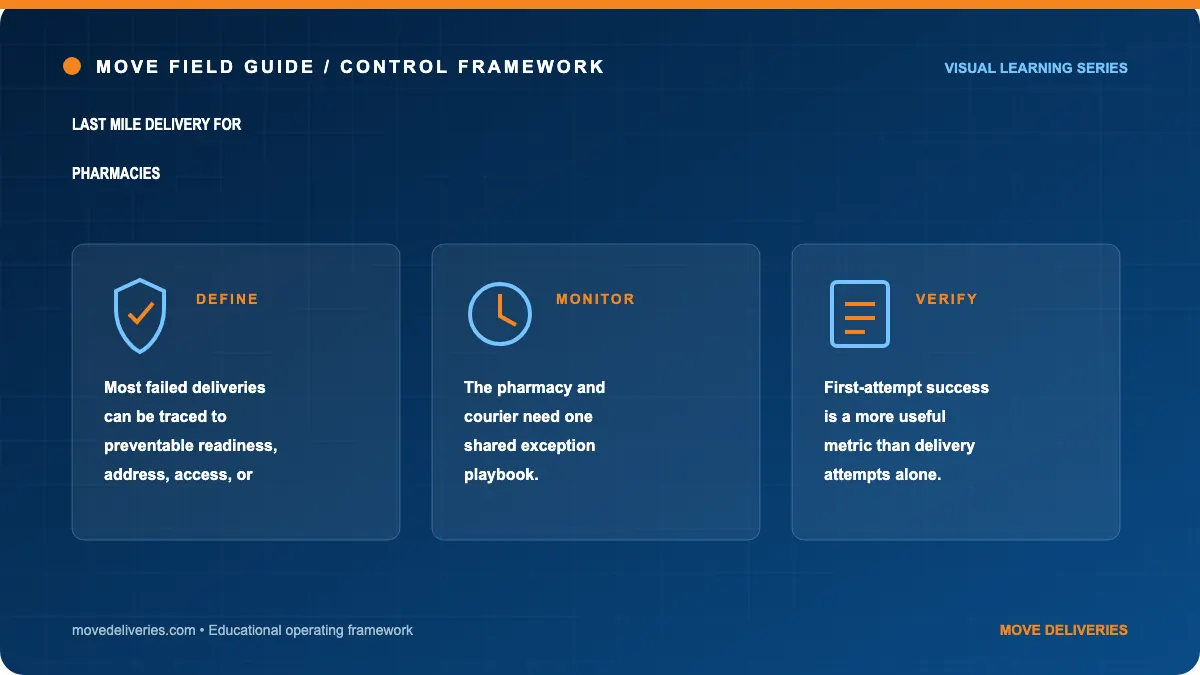
- Most failed deliveries can be traced to preventable readiness, address, access, or communication gaps.
- The pharmacy and courier need one shared exception playbook.
- First-attempt success is a more useful metric than delivery attempts alone.
Turn last mile delivery for pharmacies guidance into an operating policy
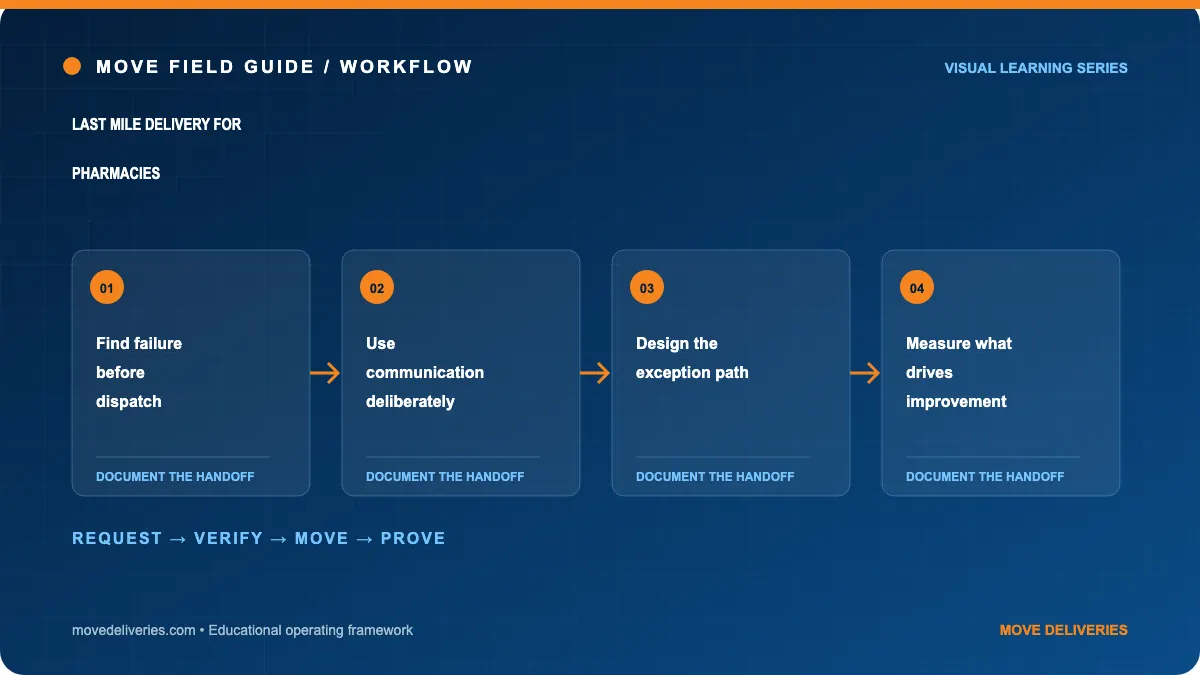
A useful policy begins with a specific operating question, not a broad promise. For this topic, the question is how to manage reducing failed delivery attempts through address quality, recipient readiness, route design, and rapid exception handling. Write down who may request the work, what information is required before acceptance, who may change the plan, and what evidence closes the task. The policy should distinguish requirements from preferences and identify the person who can resolve uncertainty. That structure matters because healthcare delivery rarely fails from driving alone. Failures are more often created by missing release details, an unavailable recipient, unsuitable packaging, an unrealistic deadline, or an exception that reaches the right person too late.
The delivery workflow should support pharmacy operations without replacing the pharmacist’s authority over dispensing, product instructions, patient communication, and exceptions. Use the existing subjects in this guide—find failure before dispatch, use communication deliberately, design the exception path, measure what drives improvement—as headings in the internal procedure, then add organization-specific owners, systems, phone paths, and time thresholds. Optimization must not override product, privacy, patient, or handoff requirements. A shorter route is not better when it creates an unauthorized or unreliable delivery. Review the policy with operations, privacy, safety, quality, pharmacy, laboratory, or legal specialists as applicable. The finished document should be short enough for people to use during a live request while still pointing to detailed procedures for unusual or regulated work.
Define responsibility at every handoff
Three roles need an unambiguous place in the workflow: the pharmacy operations team, the courier and route planner, and the patient or facility recipient. The releasing party confirms that the item is ready and that the order accurately describes the required service. The courier side confirms route acceptance, assignment, and progress. The receiving party completes the authorized handoff or triggers the documented alternative. Naming these roles prevents a familiar problem: everyone can see a delayed order, but no one knows who owns the next decision. Responsibility should transfer through explicit events, not assumptions.
Create a responsibility table for normal delivery, delay, address problem, damaged package, recipient unavailable, refusal, vehicle breakdown, and return. For each event, identify who notices it, who records it, who must be notified, who may authorize a change, and what closes the event. Avoid placing clinical or product-disposition decisions on a driver. Drivers can observe, protect, communicate, and follow instructions; the qualified customer representative should decide whether a product may be used, returned, quarantined, or replaced. Test the table in a tabletop exercise before the first live route.
Build the workflow from request through proof
Map the delivery in chronological order and define the minimum record at each stage. The core record set for this topic includes validated address and contact, recipient readiness, attempt outcome, and return or redelivery resolution. At request time, capture only information that dispatch needs to validate the route and perform the work. At acceptance, state what service window has actually been confirmed. At pickup, connect the correct courier, shipment identifier, time, and releasing location. During transport, record meaningful status and exceptions. At delivery, close the specific recipient or return requirement.
A practical example is a pharmacy validates unit numbers and recipient windows before route release, groups compatible stops, and alerts staff early enough to resolve an access issue before a failed attempt. Walk that example through the proposed system on a screen and on a phone. Verify which fields are required, which users may edit them, how corrections appear in history, what happens without connectivity, and how quickly a customer can retrieve the final record. Repeat the exercise with a failed delivery. A workflow that looks complete only when everything goes according to plan is not an operational control; it is a happy-path demonstration.
Plan for the exceptions most likely to affect the outcome
Start the exception register with incorrect apartment or facility details, recipients unavailable during the route, late exception notification, and unplanned returns that disrupt inventory. For each risk, define an observable trigger and a time-bound response. “Notify the customer if delayed” is too vague. A stronger rule states the event that starts the clock, the communication channel, the role that receives the message, the information included, and the escalation that follows when no response arrives. The purpose is not to predict every unusual event; it is to prevent a common issue from becoming an unmanaged failure.
Separate immediate containment from later review. During an active delivery, dispatch may need to protect the package, contact the shipper, redirect the courier, preserve a timestamp, or begin a return. Afterward, the organization can review root cause, corrective action, and whether a procedure or route must change. Keep both parts in the same incident history without requiring the driver to write a long narrative while stopped in the field. Structured event choices plus a concise factual note usually produce a clearer record than an unrestricted text box.
Use technology to clarify status, not to create noise
Technology should answer four questions quickly: was the request accepted, who owns the next action, where is the delivery in its approved workflow, and what evidence is available? A moving map can support that view, but it should not replace plain-language events such as assigned, traveling to pickup, picked up, delayed, arriving, delivered, returned, or exception. Notifications should go to people who can act. Repeated alerts without ownership train users to ignore the system and push them back toward phone calls and spreadsheets.
Configure access by role and organization. Customer users should see only their organization’s orders. Drivers should receive only the instructions needed for assigned work. Marketing staff should not inherit operational access. Administrators should use unique accounts, strong authentication, and audit logs. Define how long location, proof, and communication records are retained, then delete or archive them under an approved policy. Optimization must not override product, privacy, patient, or handoff requirements. A shorter route is not better when it creates an unauthorized or unreliable delivery. Good technology makes the procedure easier to follow and the outcome easier to review; it does not remove the need for qualified judgment.
Measure service quality with a balanced scorecard
A balanced scorecard for last mile delivery for pharmacies should include first-attempt delivery rate, address-correction rate, average stop time, and return and redelivery rate. Define each measure before launch. Specify the start event, end event, exclusions, time zone, data source, and review frequency. For example, “on time” is meaningless until the organization decides whether it compares arrival with a requested time, a provider-confirmed window, a laboratory cutoff, or another operational deadline. Publish the definition beside the number so teams do not argue from different calculations.
Review performance by lane, customer program, facility, service model, time of day, and exception cause—not only as a network average. A strong average can hide a weak receiving site or an unrealistic route. Pair outcome measures with leading indicators such as missing order fields, late package readiness, prolonged stop dwell, or repeated recipient changes. Those early signals let a team correct the process before they appear as missed deliveries, rejected specimens, returns, or dissatisfied patients. Use trends to ask better questions rather than to assign blame automatically.
Pilot the process before expanding volume
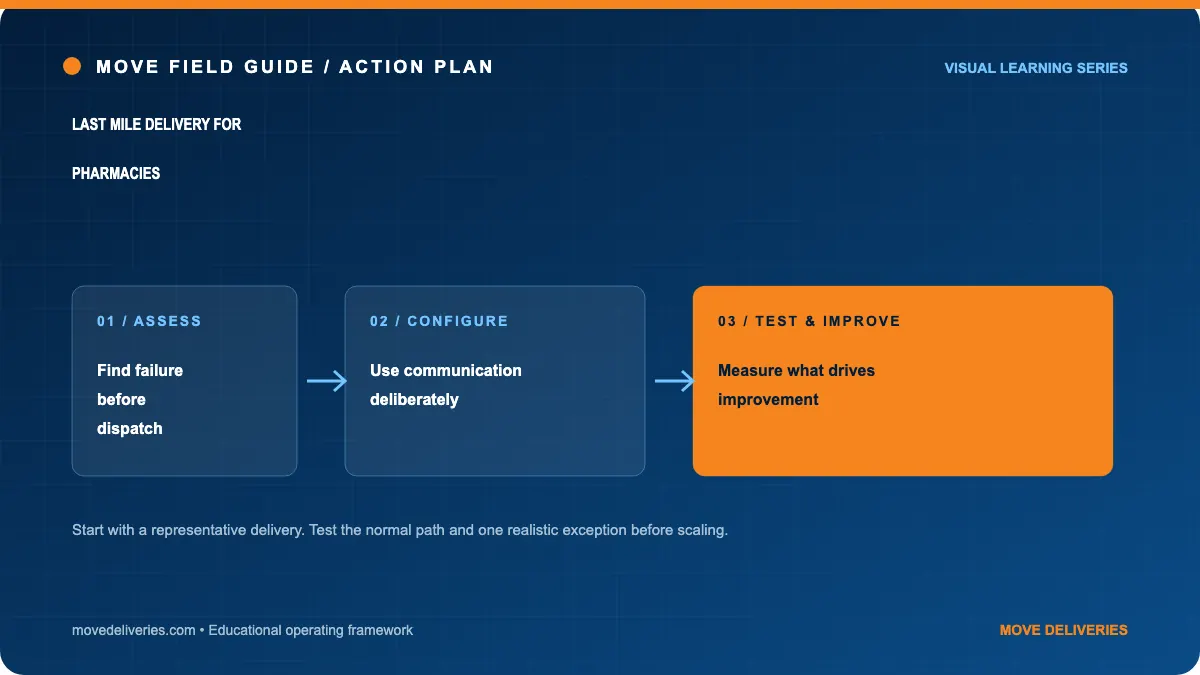
Run a controlled pilot that represents the real operation. Include ordinary work, one urgent request, one difficult site, and at least one simulated exception. Confirm contacts and backup contacts before the test. During the pilot, preserve the original order, all status events, communications, route details, handoff evidence, and any invoice assumptions. Ask the people at the origin and destination whether the workflow was understandable. A route can arrive on time and still create avoidable work if the staff cannot identify the courier, locate the record, or understand what happens next.
Set written pilot exit criteria. Examples include complete required fields, successful access at every site, acceptable status timeliness, retrievable proof, accurate billing inputs, and a resolved path for each simulated exception. Record gaps as actions with owners and dates. Do not scale simply because the first few deliveries arrived. Scale when the organization can repeat the process, recover from predictable problems, train a replacement user, and explain the complete record to an internal reviewer without reconstructing it from personal messages.
Use a 30-day implementation checklist
During the first week, document demand, shipment types, addresses, hours, cutoffs, contacts, packaging ownership, and recipient rules. In the second week, configure users, permissions, order fields, notification thresholds, routes, and exception paths. In the third week, train the people who request, release, dispatch, drive, receive, review, and reconcile the work. Run the normal and exception scenarios described above. In the fourth week, complete the pilot, retrieve sample records, compare invoice logic with the proposal, and obtain written approval from the accountable business owner.
Keep the takeaways from this article visible during implementation: Most failed deliveries can be traced to preventable readiness, address, access, or communication gaps. The pharmacy and courier need one shared exception playbook. First-attempt success is a more useful metric than delivery attempts alone. Turn each statement into a verifiable action. Assign one owner, one due date, and one piece of evidence. At the 30-day review, decide what to keep, change, stop, or investigate. Revisit the review after 60 and 90 days using the balanced scorecard rather than anecdotes alone. This cadence gives the organization enough structure to learn without treating the initial design as permanent or allowing temporary workarounds to become the operating standard.
Questions to resolve before requesting service
Before contacting a provider, prepare a representative request that includes the true origin and destination, access instructions, ready time, useful delivery deadline, shipment dimensions, weight, vehicle fit, packaging status, recipient rule, and expected frequency. Identify whether the work is a one-time urgent delivery, a scheduled pickup, a fixed multi-stop route, or dedicated capacity. Explain any temperature, privacy, security, exposure, regulated-material, return, or after-hours condition without placing unnecessary patient information in the request. Ask the provider to separate what is confirmed from what remains an assumption, and require a clear explanation of coverage, price inputs, wait time, failed-attempt handling, cancellation, and proof of delivery.
Then ask the provider to demonstrate the proposed workflow using that same request. Who validates the order? When is capacity actually committed? What does the courier see? Which events reach the customer? How is attempt outcome recorded, and how is return or redelivery resolution retrieved? Who answers an urgent exception, and what authority does that person have? Confirm that the agreement does not quietly assign the provider responsibilities that belong to the shipper or qualified recipient. Optimization must not override product, privacy, patient, or handoff requirements. A shorter route is not better when it creates an unauthorized or unreliable delivery. The best discovery conversation should leave both parties with a narrower, more accurate promise and a shared understanding of the evidence that will be available after the delivery closes.
Sources & further context
Educational guidance. Requirements depend on the shipment, transport mode and jurisdiction. This article does not establish MOVE’s certification or acceptance of a particular material.
Practical questions about last mile delivery for pharmacies
What is pharmacy last-mile delivery?
It is the final movement from the pharmacy or distribution point to the patient, caregiver, facility, or approved recipient.
How can pharmacies reduce failed deliveries?
Validate addresses and access, confirm recipient requirements, communicate realistic windows, and give drivers a fast approved exception process.
Which delivery metric matters most?
No single metric is sufficient. First-attempt success, on-time performance, exceptions, returns, and recipient complaints should be reviewed together.
Turn the guidance into a documented decision
Before making a decision about last mile delivery for pharmacies, choose one real route and walk through it with the people who release, transport and receive the shipment. Record the exact pickup location, receiving department, ready time and latest acceptable arrival. Separate requirements that are mandatory for the material from preferences that can be negotiated. This prevents a conversation about speed from overlooking the conditions that make the delivery usable.
Ask each provider to respond to the same scenario in writing. Identify the included vehicle, assumed waiting time, number of stops, handoff requirements and charges for an unsuccessful attempt. Request a sample completion record with personal information removed. An attractive dashboard is not a substitute for understanding whether a required field is captured, who can change it and how the record is retrieved when the receiving team asks a question.
Include one exception in the walkthrough: a closed receiving desk, an address correction, a delayed release or a packaging concern. Identify who makes the next decision and which contact can authorize a return or revised instruction. Do not let a driver improvise a clinical, pharmacy or product-quality decision. Confirm that the escalation path can be used during the actual operating window, including any agreed after-hours period.
Finally, agree on a small set of review measures and their definitions before expanding volume. Measure completed handoffs against confirmed windows, distinguish customer-caused delays from transport delays, and record missing information that creates repeat work. Use the first review to correct the process rather than to promise an unsupported performance percentage. A narrow, testable agreement is more useful than a broad claim that cannot be demonstrated.
Continue exploring.
Pharmacy Delivery
Pharmacy Delivery Service: How to Build a Dependable Program
Plan a pharmacy delivery service around cutoffs, service areas, patient communication, packaging, recipient verification, exceptions, and performance.
Pharmacy Delivery
Prescription Delivery: Privacy and Patient Handoff Best Practices
Improve prescription delivery privacy with better labels, notifications, recipient verification, unattended-delivery rules, and return procedures.
Pharmacy Delivery
Specialty Pharmacy Cold Chain Delivery: A Risk-Based Planning Guide
Plan temperature-sensitive medication delivery using labeled storage conditions, qualified packaging, lane risk, monitoring, handoff, and excursion procedures.
Ready to make your next move?
Get a route-specific quote or start a conversation about recurring delivery.